At-home monitoring of abnormal sleep behaviors
An AI-powered device for prolonged at-home monitoring of NREM parasomnias. A joint project between IDSIA (USI-SUPSI) and the Sleep Medicine Unit of the Neurocenter of Southern Switzerland (EOC).
The challenge
NREM parasomnias — sleepwalking, sleep terrors, and confusional arousals — affect up to 29 % of children and 4 % of adults, causing sleep disruption, daytime impairment, psychological distress, and significant injury risk. The diagnostic gold standard, video polysomnography (vPSG), is costly, available only at a small number of tertiary centers, and typically limited to a single recording night per patient. Because episodes are intermittent, nearly half of recorded nights capture no clinically relevant event. Multi-night home recording would close this gap — but the resulting data volume is far beyond what a clinician can review manually.
Our approach
We are building an end-to-end pipeline that combines:
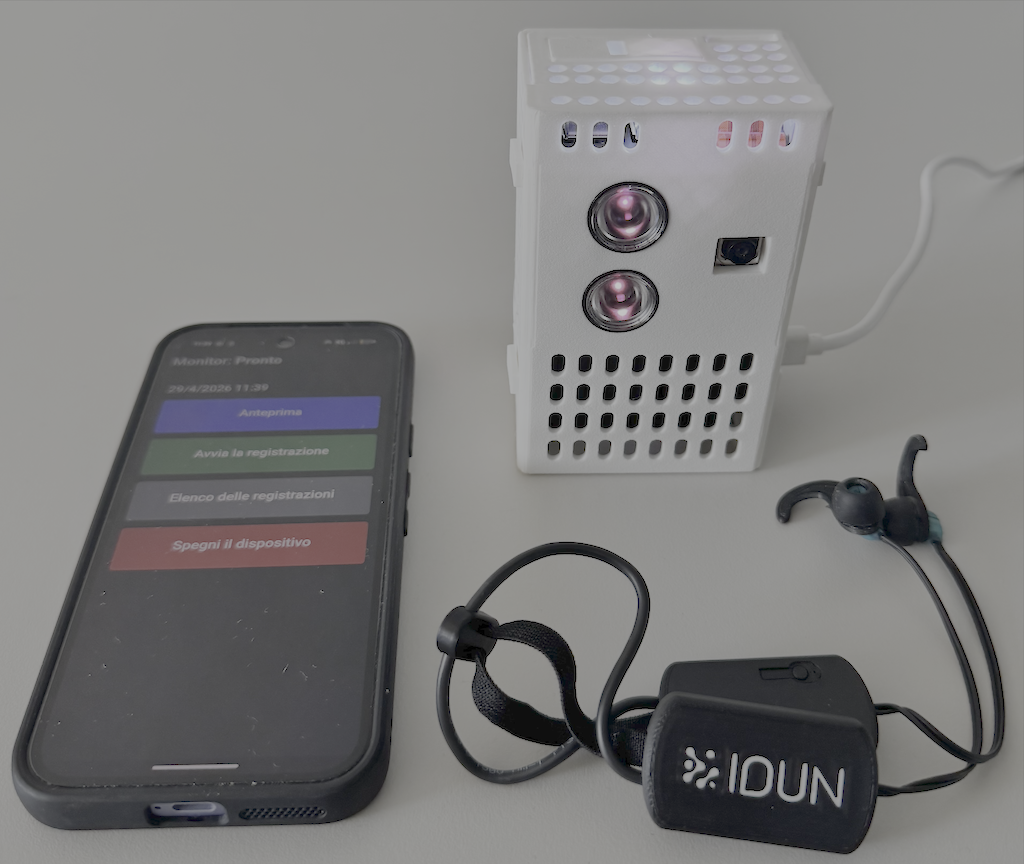
- A compact at-home recording device with a near-infrared camera and microphone, designed for unobtrusive overnight use in the patient’s own bedroom.
- Optional integration with commercial sleep-analysis wearables (e.g., IDUN Guardian earbuds, MUSE band) to provide sleep-stage information without clinical-grade electrode placement.
- A causal AI model that jointly analyzes video and sleep-stage information to detect NREM parasomnia episodes — and that can, in principle, operate in real time during acquisition, enabling future bedside alerting.
Key results
Example of NREM parasomnia detection


Example of physiological movement detection


Evaluated on 52 overnight recordings from 39 participants (children and adults), using leave-one-night-out cross-validation:
- Segment-level AUC: 0.905 (sensitivity 0.833, specificity 0.842)
- Night-level AUC: 0.979 (sensitivity 0.944, specificity 1.000)
The night-level metric directly answers the question clinicians actually ask — “Does this recording night contain a parasomnia episode?” — and reaches near-perfect discrimination with zero false positives on our test set. The system also produces visual attribution maps that highlight which body regions drove each detection, supporting clinician trust.
Team
IDSIA, SUPSI/USI — Machine learning & AI methods R. Omar Chávez García · M. Camila Sebastiani · Alessandro Giusti
Sleep Medicine Unit, Neurocenter of Southern Switzerland (EOC) — Clinical lead Anna Castelnovo · Marco Veneruso · Mauro Manconi
University of Genova & IRCCS Istituto Giannina Gaslini — Pediatric sleep medicine Lino Nobili · Marco Veneruso
Partners & support
Funding: Innosuisse — Swiss Innovation Agency, grant no. 112.736 IP-LS Wearable partners: IDUN Technologies AG · InteraXon Inc. Clinical partners: Ente Ospedaliero Cantonale (EOC) · IRCCS Istituto Giannina Gaslini